
Does buying CTV directly actually save money?
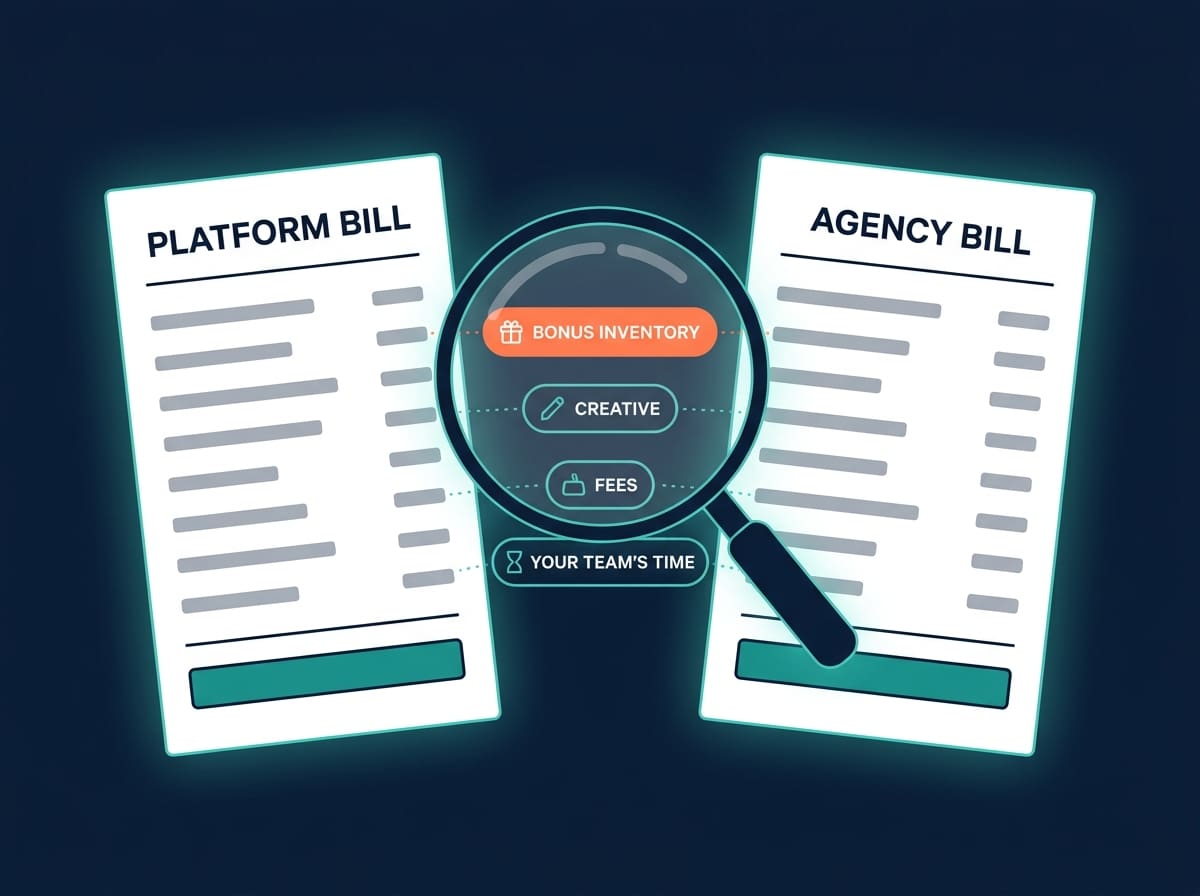
Going direct can save money when it eliminates agency retainers, management fees, or separate creative charges that the agency cannot justify through additional value. It does not automatically reduce the total cost of getting a customer and those charges are not part of every agency’s model.
An experienced agency may negotiate better media rates, secure valuable bonus inventory, and improve creative or conversion. Weigh those advantages against its complete compensation arrangement and the actual inventory delivered.
The comparison is simple to state and easy to get wrong: Which arrangement gives your business the better result for the complete investment?
If you only compare the platform bill with the agency bill, you may be leaving the most important numbers out.
Start with the same buying assignment
Before comparing prices, make sure you are comparing comparable inventory: audience, geography, screen type, publishers or programs, frequency controls, and campaign timing.
A lower cost per thousand impressions is not necessarily a better buy if those impressions reach less relevant viewers or provide less useful reporting.
Ask what is included in the quoted price. Are there data or technology charges? Creative costs? Management fees? What does your internal team need to contribute?
The invoice is part of the cost. The work required to make the campaign function is another part.
The standard discount may not distinguish the offers
In arrangements where a direct advertiser receives the same standard discount available through an agency, going direct creates no additional savings on that base rate.
Suppose both receive a 15% discount. Neither offer wins merely by displaying that number. The next questions concern additional negotiated reductions, fees, inventory quality, and bonus placements.
The 15% figure is an example of a buying arrangement, not a universal rule for CTV platforms. Some purchases use auction pricing; others involve negotiated commitments. Ask about the actual terms in front of you.
Where agency buying leverage can create value
An agency placing multiple advertisers can bring combined spending and established relationships to a negotiation. Depending on the arrangement, those relationships may secure rates beyond the standard discount or additional inventory without an additional media charge.
That bonus inventory can extend delivery or create opportunities to test other programs and dayparts. It has value when the placements fit the campaign, not simply because more impressions appear in a report.
Ask whether savings are passed through, which placements are paid versus bonus, and how results from expansion tests will be reported.
Neither a negotiated discount nor a relationship is a guarantee. They are buying advantages to verify in the proposal and delivery report.
First account for fees, retainers, and minimums
A monthly retainer, management charge, creative invoice, and agency-required spending commitment can make the same campaign materially more expensive. If those costs exceed the value the agency adds, direct buying may be the better economic choice.
Distinguish agency minimums from platform or publisher minimums. A spending requirement is a commitment, not necessarily an added fee, but it can force a larger test than the business wants or can justify.
At ADcology, there are no retainers, management fees, or separate creative fees. We earn placement commissions, and continued bookings hinge on performance. Compare our total media proposal with direct buying rather than assigning us charges we do not make.
This is not a claim that commission-based buying always wins. Rates, inventory quality, included services, reporting, and business results still determine value.
A worked example: how compensation changes the comparison
The following is hypothetical. It is not an ADcology client result or a claim about any platform’s pricing.
Assume both arrangements start with a $40 CPM and receive the same 15% discount, reducing the base rate to $34. The direct advertiser buys one million impressions for $34,000.
For each agency example, assume a further 10% negotiated reduction from the discounted rate and 200,000 bonus impressions of comparable quality. Compare an agency charging a $4,000 management fee with an arrangement that has no separate management fee. In the latter, assume agency compensation is already included in the quoted media cost; it must not be added again.
| Buying measure | Platform direct | Agency with fee | Agency without separate fee |
| Starting CPM | $40.00 | $40.00 | $40.00 |
| After shared 15% discount | $34.00 | $34.00 | $34.00 |
| Further rate reduction | None assumed | 10% off $34 | 10% off $34 |
| Paid impressions | 1,000,000 | 1,000,000 | 1,000,000 |
| Quoted paid media cost | $34,000 | $30,600 | $30,600 |
| Separate management fee | $0 | $4,000 | $0 |
| Bonus impressions | None assumed | 200,000 | 200,000 |
| Delivered impressions | 1,000,000 | 1,200,000 | 1,200,000 |
| Media + management total | $34,000 | $34,600 | $30,600 |
| Effective CPM | $34.00 | $28.83 | $25.50 |
The fee-charging example costs $600 more than direct buying and delivers 20% more impressions, with an effective CPM of $28.83. The no-separate-fee example costs $3,400 less than direct buying and has an effective CPM of $25.50, a 25% reduction under these assumptions.
That is better delivery value under the assumptions. It is not proof of better ROAS or lower customer acquisition costs.
Calculate effective CPM by dividing total media and separately charged management costs by delivered impressions, then multiplying by 1,000. Creative, data charges, and internal labor are excluded here; include relevant costs in your actual comparison. Confirm comparable bonus delivery and whether the quoted media price includes agency commission.
These are illustrative arrangements, not actual ADcology prices or promised results. If bonus placements are less relevant, costs differ, or negotiated benefits are unavailable, the conclusion changes. Direct advertisers can also negotiate bonuses; count any they receive.
Bonus inventory can fund learning
Additional placements can help explore an audience, show, or daypart before you commit more paid budget. That can make the agency relationship valuable beyond the initial price negotiation.
But design the test, identify what you want to learn, and what evidence would justify expansion. Where the reporting permits, separate test placements from the established campaign.
Avoid treating bonus impressions as free proof of success. They still use your creative, management attention, and the audience’s attention. Their results may also differ from a later campaign with different scale, timing, or frequency.
The benefit is a lower media cost of exploration, with a clearer basis for the next decision.
The larger savings may occur after the impression
A commercial can reach the intended audience at a competitive rate and still fail to produce profitable customers.
The message may leave a key objection unanswered. The offer may lack a reason to act. The landing page may be confusing. Calls may go unanswered. Leads may receive weak follow-up.
An experienced agency can help identify and address those issues. That is why a weekly working session should include conversion and customer economics, not just delivery.
If improving the response journey produces more qualified customers from the same media investment, that improvement belongs in the value comparison. It must be measured rather than assumed. Also ask whether the proposed creative and conversion support is included or charged separately.
Compare customer economics, not just reported ROAS
Use total acquisition costs and an outcome that matters to the business. For example, divide the relevant acquisition investment by genuinely incremental new customers when you can estimate that number credibly.
Do not substitute all platform-attributed purchases for incremental customers without examining the attribution. A platform may credit a conversion after an exposure even when another channel also influenced it. Roku’s reporting documentation illustrates how attribution systems can produce different conversion counts.
Then consider contribution margin, refunds, repeat purchases, and cash timing. A larger order is helpful only to the extent that its economics are sound. A lifetime-value projection deserves different confidence from observed repeat-purchase results.
A capable agency should welcome these questions. Better media terms are valuable, but the business still needs to make money.
The questions to put beside every proposal
What is the all-in media rate? What fees and production costs sit outside it? What internal work remains? Are bonus placements guaranteed, comparable, and disclosed? Who receives negotiated savings? What reporting supports decisions? How will we evaluate actual acquisition economics?
Put those answers side by side. You may find that direct buying is the better deal. You may find that agency leverage and included expertise produce better value.
At ADcology, we believe the comparison should include the complete buying package and the customer journey. Going direct is a purchasing method. Saving money is a result you need to demonstrate.
Take the next step:
- Read this article for a readiness checklist
- Read this article for a full capabilities comparison
- You can also review how we approach TV and CTV advertising
