
Your Search and Social Ads Are a Slot Machine — And the House Always Wins
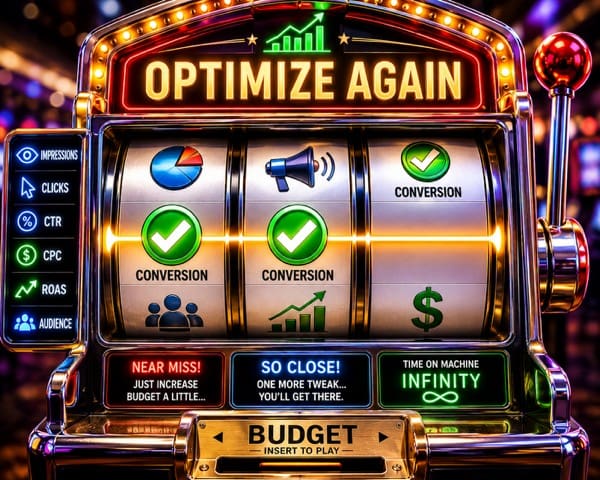
The psychology that keeps a gambler glued to a slot machine — variable rewards, losses dressed up as wins, the trance of the “machine zone” — is the same psychology Google and Meta use to keep you spending. A behavioral look at why you can’t out-optimize the house — and where to move your chips so the odds finally tip your way.
Walk a casino floor and listen. It sounds like everyone is winning — bells, jingles, coins, a little fanfare every few seconds. Almost none of them are. That sound is one of the most sophisticated pieces of behavioral engineering of the last century, and it was built to do exactly one thing: keep you in the chair.
First as a SWAT hostage negotiator, then as a Doctor of Psychology, and now as an advertising behavioralist, I’ve spent my career studying why people do what they do. And here’s the most uncomfortable thing I’ve learned in advertising: the machine that keeps a gambler pulling a lever and the dashboard that keeps a marketer raising a bid run on the same psychology. Not a similar psychology — the same one. Google and Meta didn’t invent it. They borrowed it from the casino, and they aimed it at you.
Skinner’s lever
The foundation traces back to the psychologist B.F. Skinner. Working with animals in the 1950s, Skinner mapped how different schedules of reward shape behavior, and he found that one schedule beat all the others at producing relentless, repetitive action: the variable-ratio reinforcement schedule. Reward the subject not every time and not on a predictable count, but after an unpredictable number of responses, and you get the highest, steadiest rate of behavior — and the behavior most resistant to extinction. In plain terms: when you can’t predict which press will pay off, you keep pressing long after a rational actor would have quit.
That one finding is the beating heart of every slot machine ever built. It is also the beating heart of your ad account. You launch a campaign and most days are quiet. Then — unpredictably — a day, a creative, or a keyword hits, and the dashboard rewards you. You can’t predict which push will pay, so you keep pushing, keep funding, keep optimizing. Surprise… Skinner described your media plan in 1957.
Losses disguised as wins
Skinner explains why you keep playing. A psychologist named Mike Dixon explains why you can’t tell you’re losing.
Dixon, a professor at the University of Waterloo who has spent decades studying gambling, identified and named a phenomenon in modern slot machines: the loss disguised as a win. On a multiline machine you bet on several lines at once. You might wager a dollar and “win” thirty cents back. That is a seventy-cent loss. But the machine doesn’t treat it like one — it erupts in the same lights, sounds, and celebratory animation it uses for an actual win. Dixon’s lab showed that players’ bodies respond to these disguised losses the way they respond to real wins, and that players walk away remembering far more wins than actually happened; the celebratory sounds alone push people to overestimate how often they won. The machine congratulates you for losing money, and your nervous system believes it.
Now open your ad dashboard. Watch the platform-reported conversions tick up, the ROAS glow green, the little spikes that feel like progress. After the privacy changes of the last few years gutted the accuracy of that attribution, a meaningful share of those celebrated “wins” are losses — conversions that would have happened anyway, spend that never moved the needle, numbers that don’t survive contact with true incrementality. The dashboard is the casino’s lights and bells. It is engineered to make a loss feel like a win — and, like the gambler, you remember the wins.
The near-miss and the illusion of control
Two more mechanisms close the trap. The first is the near-miss — cherry, cherry, and almost-cherry, the symbol that lands one row short of the jackpot. Decades of research show the near-miss fires the brain’s reward circuitry (“So close”) almost as hard as a win and pushes players to keep going. In your account it sounds like this: you were so close to profitable. Just tighten the targeting, lift the budget a little, test one more hook, and you’ll get there. The near-miss is the campaign that almost worked.
The second is the illusion of control. Slot designers hand players choices — which machine, when to press, which bonus to pick — that make a purely random outcome feel like a game of skill. Ad platforms hand you a cockpit: bids, audiences, placements, creative, dayparting, lookalikes. Those levers are real enough to feel like mastery, and that feeling is precisely the point — it keeps you believing the next adjustment is the one that finally cracks it. But you are pulling levers inside a system whose larger outcome the house has already fixed. This is why “just be smarter” fails as a strategy. A more skilled gambler is still a gambler. Your effort is real; it’s simply being spent inside a game built so that effort, in aggregate, flows to the house.
The machine zone
The anthropologist Natasha Dow Schüll spent fifteen years inside Las Vegas studying how all of this fits together, and her book Addiction by Design gave the experience its name: the “machine zone.” It’s the trancelike state in which time, worry, and even bodily awareness dissolve — and here is the part that matters most: players in the zone are no longer playing to win. They’re playing to keep playing. Schüll documented how the entire apparatus, from the algorithms to the ergonomics to the architecture, is engineered toward a single industry metric: “time on device.”
If that phrase makes you think of something other than a casino, you’re paying attention. Schüll herself has noted that her work became a touchstone for understanding social media and the smartphone. The same design logic now runs the tools you work inside all day. The real-time dashboard, the endless optimization, the pull to check performance one more time — that is time on device, aimed at the marketer. You’re not only buying from the machine. You’re in the zone.
The bet you didn’t know you raised
Here is where the ad platform out-engineers the casino. A slot machine still needs you to choose to bet more — to play max lines, to move up to the dollar machine. The ad auction raises your bet for you.
Every advertiser chasing the same customers bids in the same real-time auction, and as everyone optimizes toward the same targets, the price of attention climbs. You don’t decide to pay more; the market does it to you, a little at a time, too gradually to notice in any single week. The longer arc is stark: customer acquisition costs have risen more than 200 percent over eight years, and CPMs in competitive categories climb by double digits year over year. Meanwhile the autobidding tools the platforms encouraged you to adopt will quietly lift your bid to “hit target” on your behalf. In the casino, you at least pull the lever to raise your own wager. Here, the machine reaches over and does it for you while you watch the lights.
Why you can’t win big
None of this requires a conspiracy. It only requires an auction. When you and every competitor bid against one another for the same impressions, your gains come at each other’s expense while the surplus pools in the middle — with the platform. Economists at Yale who modeled these auctions found that a platform designing the game to maximize its own revenue can structure it so that advertisers, in equilibrium, are left with essentially no net profit, the value flowing to the house. The “managed” and automated campaign tools, the same work found, are tuned to maximize the platform’s revenue — not your margin.
Let me be fair, because the analogy has a limit and an honest argument is the stronger one. A slot machine is pure chance with a fixed, certain house edge; advertising is not. Real value gets created, real customers are won, and genuinely skilled operators do outperform the average. So the claim isn’t that you can never win a hand. The claim is subtler, and worse: the casino was never built on the premise that every gambler loses every bet. It was built so that you win just enough to stay at the table while the house, over time and across everyone, clears its edge. The platforms have rebuilt exactly that — enough real wins to keep you spending, levers to make you feel skilled, metrics that disguise the losses, and an auction that competes your advantage away. Skill still matters. It’s just being exercised inside a game the house designed to win.
The casino that grades its own homework
One last comparison is worth sitting with, and it doesn’t flatter the platforms. In most jurisdictions a real casino is legally required to certify its odds and disclose its payback percentage; the randomness is audited by an outside authority. The ad platforms disclose neither the true mechanics of their auctions nor the real incremental effect of your spend — and then they report to you, in their own dashboard, whether you won. They deal the cards, set the odds, take the rake, and grade their own homework. By that standard, the casino on the Strip is the more transparent operation.
Don’t switch tables. Leave the casino.
Here’s the trap inside the trap. Once you see the slot machine for what it is, the instinct is to hunt for a better game — a smarter bidding strategy, a new platform, a cleverer channel. But blackjack is still the house’s table. The odds are a little friendlier and the house still wins, because every game on the floor is built on the same edge. Trading slots for blackjack isn’t an escape. It’s a rounding error.
The actual move is to pick up half your chips and walk out — not to a different gamble, but to a table where the payout is consistent because it isn’t a gamble at all. I say half deliberately. You don’t have to abandon Google and Meta, and you won’t; some of your spend genuinely belongs there. What changes your economics is reallocating a meaningful slice of budget out of the rigged auction and into channels that routinely outperform every game on the casino floor. And what makes those channels consistent rather than lucky is the one thing a slot machine can never offer: you stop betting on chance and start acting where knowledge and skill can win.
Where the payout is consistent
The casino pays on variable reinforcement — randomly, just enough to keep you spending. The channels where the smart money is moving pay on something else entirely: trust, expertise, and knowing exactly who you’re talking to.
Start with the trust. When a podcast host an audience has listened to for years recommends a product, it doesn’t land like an ad; it lands like a tip from a friend — and the data is lopsided. Among weekly podcast listeners, 56 percent say the host is the most influential voice in their decisions, versus 20 percent for social-media influencers, 15 percent for TV and film celebrities, and 10 percent for AM/FM radio hosts, according to Cumulus Media and Signal Hill Insights. Roughly three in four listeners rate host-read ads the most trustworthy format they encounter, and Acast’s 2025 Podcast Pulse found that 67 percent have bought something because a host recommended it and 85 percent took some brand action after hearing it. That is not a machine paying you back thirty cents on the dollar. That is a consistent return, because it runs on credibility instead of chance. And it isn’t only audio: more than 90 percent of U.S. households now own a connected-TV device, YouTube creators command living-room screens at a scale that increasingly rivals traditional television, and national radio personalities carry that same vouched-for authority across their markets.
Notice what these channels share, and why the odds flip. You are not bidding against every competitor for the same impression in the same millisecond, so there is no auction quietly ratcheting up your price. You buy a relationship at a negotiated rate, and a trusted voice transfers their credibility to you. Escape the auction, gain the endorsement — that is the structural reason the payout steadies.
But trust is only half of why this stops being a gamble. The other half is knowing — and that is where ADcology comes in. We don’t place bets and hope. We behaviorally profile your actual customers, then match them to audiences across the entire media spectrum. Because we know how your customers think, what motivates them to buy, how to speak to them, and where the like-minded congregate — which show, which creator, which daypart, which screen — we aren’t playing the odds. We’re removing them. The randomness that defines a casino game is precisely what behavioral precision eliminates. You don’t win because you found a luckier table. You win because you stopped gambling and started knowing.
A fair objection: the casino at least hands you a scoreboard, and these channels can feel harder to measure. That gap has closed quickly — host-read, traditional and connected-TV, and creator performance are far more measurable today in ways they weren’t a few years ago — and a number you can trust on a consistent channel beats a glowing number on a rigged one that quietly deceives you.
One last thing, and it’s the reason not to wait. The brands quietly outperforming right now are the ones who already moved. While you keep feeding the auction and watching the lights, your sharpest competitor is buying trust at negotiated rates and compounding an advantage you can’t bid your way back into. The house will happily keep your seat warm forever. The winning move was never to play its game more cleverly. It’s to pick up half your chips, walk to the table where knowing beats luck — and let the people who actually understand your customer put you in front of them.
