You Know Who Your Customers Are. But Do You Know What Makes Them Buy?
Most marketers know exactly who their customers are.
- They know their age.
- Their income.
- Their interests.
- Their buying habits.
- Their media consumption.
- Their geography.
They’ve built customer avatars, buyer personas, and demographic profiles.
But here’s the question:
Do you know what actually makes them buy?
- Not what they say.
- Not what they click.
- Not what they search.
- What actually persuades them to take action?
Before I spent decades helping advertisers persuade consumers, I spent years as both a SWAT hostage negotiator and therapist.
Those two careers taught me the same lesson.
During my years as a hostage negotiator, I learned that simply being right was often irrelevant. The question wasn’t whether my message was true. The question was whether the person listening was prepared to receive it.
One of the first surprises I encountered as a negotiator was realizing that two people in nearly identical situations could respond completely differently to the same message. One wanted facts. Another wanted reassurance. Another wanted to tell their story before they would listen to mine.
The message wasn’t the issue.
The method of delivery was.
Therapy reinforced the same lesson. I could explain the identical insight to five clients and receive five completely different reactions. One would immediately understand. Another would need an analogy. Another would need a story. Another would need evidence. Another would reject the idea entirely until they discovered it for themselves.
Advertising continues to prove the same principle every day.
People don’t all accept information the same way.
The message may be identical, but how it’s delivered often determines whether it is accepted, rejected, trusted, or ignored.
- Some people want the facts.
- Some want social proof.
- Some want an analogy that helps them understand.
- Some want a story from someone who’s already been there.
- Some want to know what happens if they do—or don’t—act.
- Some want an expert to tell them what to do.
- Some resist being told what to do.
- Some seek reassurance.
But almost everyone is trying to avoid making a mistake.
The fastest way to fail as a hostage negotiator was to assume that because a message made sense to me, it would automatically make sense to the person holding the gun.
The fastest way to fail as a therapist was to assume that because I understood the solution, the client was ready to hear it.
And the fastest way to fail as a marketer is to assume that consumers are persuaded by information alone.
They aren’t. Not unless that information is delivered in a way they are naturally inclined to trust.
Marketing’s Blind Spot
The advertising industry spends billions trying to determine where consumers are.
It spends surprisingly little time trying to understand how consumers decide.
Modern marketers spend enormous effort identifying:
- Age
- Gender
- Income
- Geography
- Interests
- Purchase history
We obsess over where consumers spend their time.
But we rarely ask a more important question:
How does this audience naturally decide what to trust?
That’s the missing layer.
Because persuasion occurs not when a message reaches the right person, but when it reaches them in the format their brain is naturally prepared to receive.
Most consumers are trying to solve the same problem:
How do I move forward without making a costly mistake?
The difference is that they use different methods to arrive at confidence.
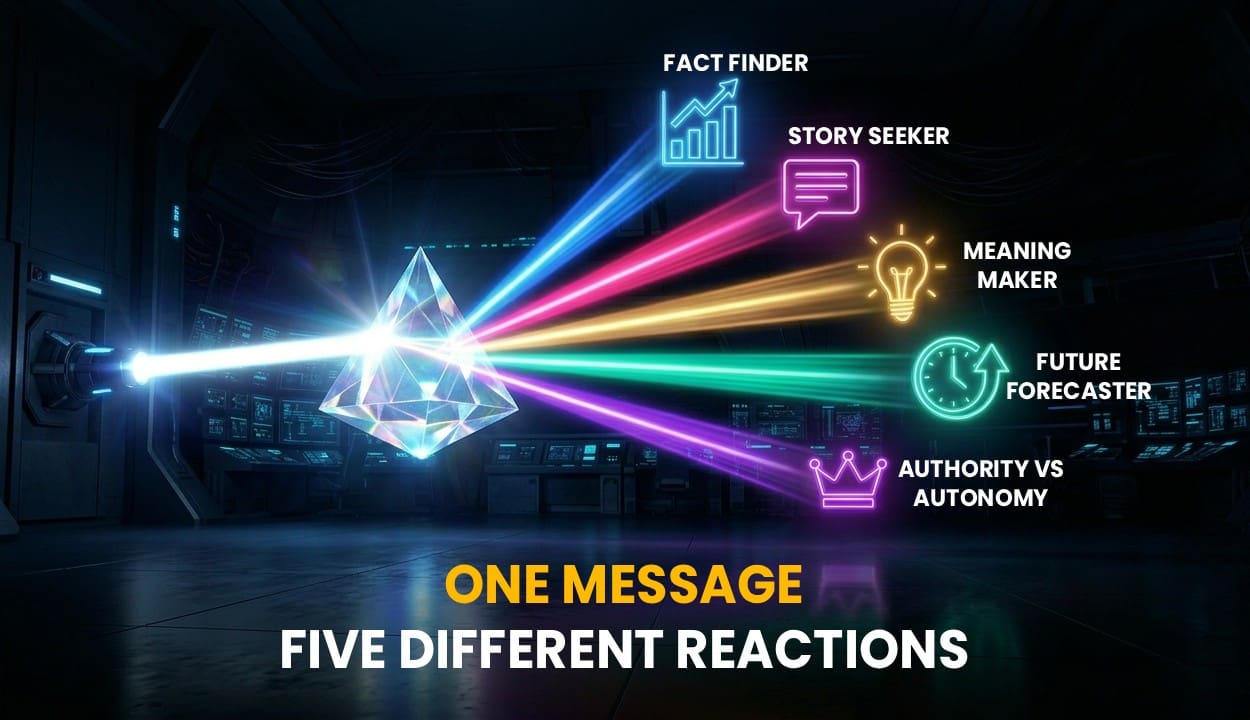
Five Common Trust Styles
1. The Fact Finder
The Fact Finder wants evidence. Their first question is:
“How do I know this is true?”
They respond to:
- Clinical studies
- Statistics
- Demonstrations
- Expert opinions
- Comparisons
These consumers often distrust emotional claims until they’ve seen proof.
2. The Story Seeker
The Story Seeker trusts experience. Their question is:
“Has someone like me already been through this?”
They respond to:
- Testimonials
- Case studies
- Founder stories
- Host endorsements
- Customer experiences
Before they buy the solution, they need to see themselves in the story.
3. The Meaning Maker
The Meaning Maker wants understanding. Their question is:
“Can you help me make sense of this?”
They respond to:
- Analogies
- Frameworks
- Teaching
- Demonstrations
- Explanations
They aren’t buying information. They’re buying clarity.
4. The Future Forecaster
The Future Forecaster thinks in outcomes. Their question is:
“What happens if I do nothing?” or “What could happen if I take action?”
They respond strongly to:
- Before-and-after scenarios
- Opportunity cost
- Risk avoidance
- Regret prevention
- Aspirational outcomes
Many successful direct-response campaigns are built almost entirely around future forecasting.
5. Authority vs. Autonomy
This may be the most overlooked distinction in advertising.
Some consumers want an expert to tell them what to do.
Others resist being told what to do.
The first group is reassured by authority.
The second group is reassured by freedom.
The same message can attract one group and repel the other.
Understanding which audience you’re speaking to can dramatically alter creative performance.
Why Campaigns Fail
Most marketers assume poor performance means:
- Bad media
- Weak creative
- Wrong audience
Sometimes that’s true.
But often the problem is simpler.
The message is speaking to the wrong trust style.
Imagine:
- A Fact Finder receives a celebrity endorsement.
- A Story Seeker receives a clinical study.
- A Future Forecaster receives a feature list.
- An Authority Seeker receives vague options.
- An Autonomy Seeker receives commands.
The message isn’t wrong. It’s mismatched.
And mismatched messages create friction.
Why Media Planning Must Evolve
This insight doesn’t only affect creative.
It affects media.
Different environments naturally attract different trust styles.
- Search attracts Fact Finders.
- Podcasts often attract Story Seekers.
- Long-form educational content attracts Meaning Makers.
- Authority-driven programming attracts Authority Seekers.
- Community-driven platforms often attract Autonomy Seekers who prefer to conduct their own research.
The question is no longer:
“Where does my audience spend time?”
The better question is:
“How does my audience decide what to trust and where do those people gather?”
When media and message align with decision style, performance improves dramatically.
The Future of Advertising
The advertising industry has become exceptionally good at finding consumers.
But finding consumers is no longer enough.
The next evolution is understanding how they decide.
Most marketers segment consumers by demographics.
Some segment them by psychographics.
Very few segment consumers by how they decide what to trust.
Yet trust is where every buying decision begins.
Looking back, it’s interesting that the same lesson followed me from SWAT negotiations to therapy offices to advertising agencies.
People don’t buy because they receive information.
They buy because the information arrives in a form they are prepared to trust.
Until marketers understand that distinction, they’ll continue searching for better media, better offers, and better creative when the real problem may be much simpler.
They’re speaking a different decision-making language than the customer they’re trying to persuade.
Because persuasion is not the transfer of information.
Persuasion is the successful reception of information.
