The End of Easy Scale: Why Digital Advertising Is Breaking Down—and What’s Replacing It
How behavioral psychology—not platform mechanics—is becoming the new driver of scalable growth.
The era of companies soaring almost overnight—from startup to millions in sales on Facebook and Instagram—is coming to an end.
For years, those platforms created something close to a gold rush. If you had a decent product, a compelling message, and a basic understanding of targeting, you could scale—sometimes aggressively, sometimes almost effortlessly.
That environment no longer exists.
Today, many top marketing analysts—and more importantly, operators in the trenches—are seeing the same thing: campaigns that used to scale cleanly are now stalling, fragmenting, or becoming increasingly difficult to sustain profitably.
And companies are scrambling to replace what used to work.
Our founder, CEO, and doctor of psychology, Greg Cynaumon, Ph.D., weighed in:
“The reasons are many and complex. But aside from changing ad rules, user drop-off, ad saturation, and general consumer burnout, the biggest factor is this: large brands are now willing to overspend—and outspend—smaller companies to dominate the same audiences.”
Why Digital Ad Platforms Are Structurally Working Against Your Profitability
Most marketers are looking for a tactical answer: better creatives, better hooks, better funnels.
And yes—those matter. But they’re not the root issue. The root issue is structural.
Digital ad platforms operate on auction-based systems designed to maximize their revenue—not your profitability.
As more advertisers enter the system, and as larger brands become less sensitive to return thresholds, the cost of attention rises. Campaigns don’t stop working—they just stop working well. They stabilize at a level where results are acceptable, but true scalability becomes elusive. And that stability point often sits exactly where companies will keep spending… even as margins quietly erode.
The Hidden Tax on Success: Paying for Your Own Customers
As soon as you begin creating demand, you’re no longer the only one benefiting from it.
Competitors bid on your brand terms and high-intent keywords—positioning themselves in front of customers you already paid to acquire. You are now forced to defend your own demand.
This raises acquisition costs, weakens loyalty, and allows competitors to intercept high-intent buyers at the final moment of decision.
It’s a quiet but very real tax on success.
Five Forces Quietly Killing Facebook and Instagram Ad Performance
- Big Brand Pressure – Larger companies outspend smaller players
- Audience Saturation – Consumers see more ads and respond less
- Creative Fatigue – Winning ads burn out quickly
- Signal Degradation – Targeting is less precise
- Platform Bias – Algorithms optimize for spend, not margin
Together, these forces compress performance across the board.
Why Psychology Is Becoming the New Advantage in Advertising
As a doctor of psychology, I see this shift differently. Digital marketing used to be driven by mechanics—targeting, optimization, efficiency.
Now it’s being driven by behavior:
- What captures attention
- What builds trust
- What reduces resistance
- What creates action
In today’s environment:
- Trust outweighs targeting.
- Relationship outweighs interruption.
- Endorsement outweighs impression.
What’s Replacing It: The ADcology Behavioral Model
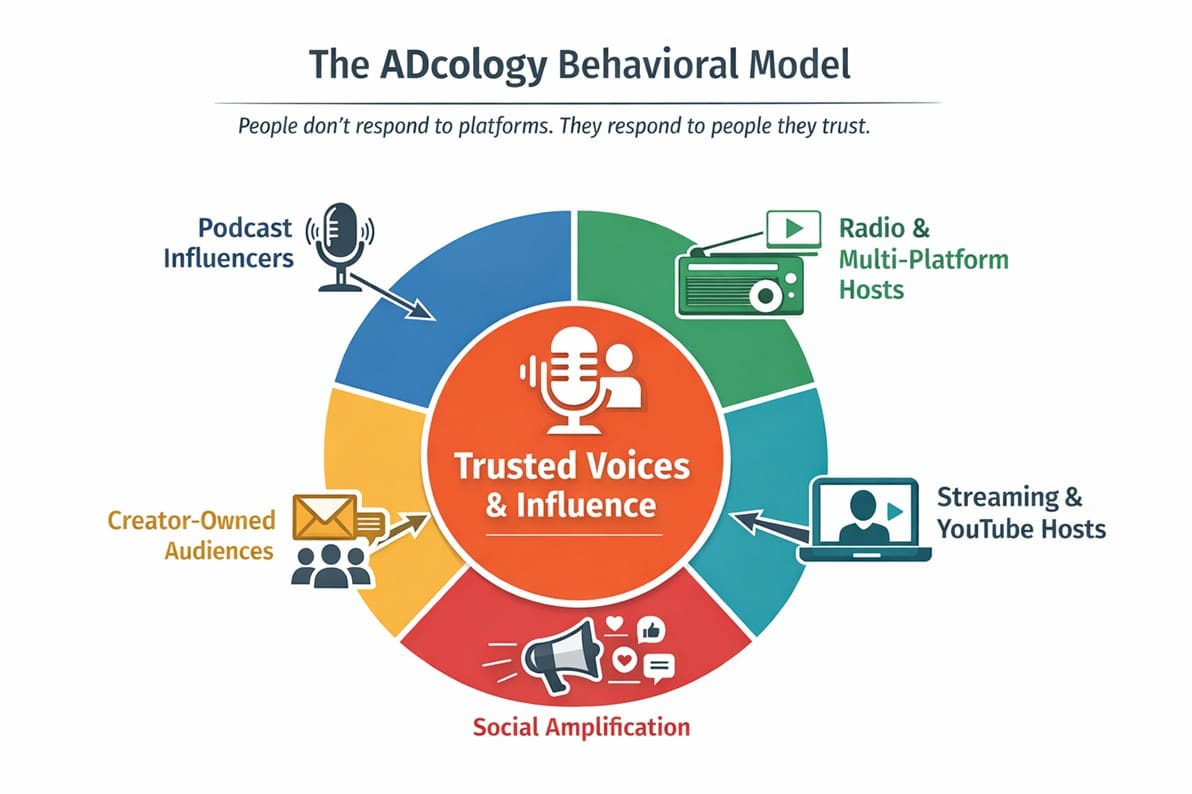
People don’t respond to platforms. They respond to people they trust.
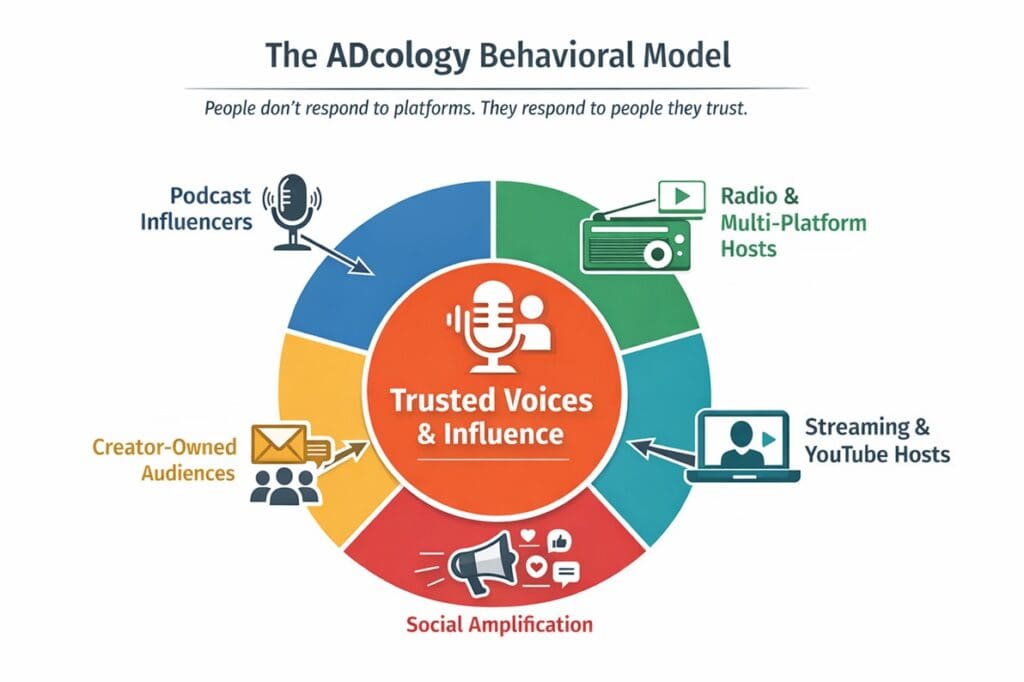
This model reflects a shift toward influence-driven ecosystems:
- Podcast influencers create long-form trust
- Radio personalities extend into multi-platform influence
- Streaming and YouTube hosts blend content and persuasion
- Social becomes amplification—not the source of trust
- Creator-owned audiences (email, SMS, communities) become the most stable asset
This is not diversification—it is a reordering of what drives performance.
Final Thought
If your campaigns feel harder than they used to…
If scaling feels more fragile…
If profitability feels tighter…
You’re not imagining it. You’re experiencing the new reality of digital advertising.
If you’re curious how your current media mix stacks up against this model, we’re happy to take a look.
